
Table of Contents
- What Is Specialty Coffee (And Why It Costs More)
- Specialty Coffee vs Regular Coffee: What Actually Changes in Your Cup
- Organic Coffee: What the Label Does and Doesn't Guarantee
- Best Coffee Brewing Methods for Specialty Beans
- How to Choose and Store Specialty Coffee Beans
- Flavor Notes, Origins, and Processing Methods Explained
- Frequently Asked Questions
Last Updated: October 6, 2026
What Is Specialty Coffee (And Why It Costs More)
Specialty coffee is coffee that scores 80 points or higher on a 100-point scale set by the Specialty Coffee Association, a standard that measures flavor, aroma, acidity, body, and balance. This guide from Coffee Love explains what that score means in practice, how beans earn it, and why the price gap between specialty and grocery-store coffee is real rather than marketing.
Most people drink coffee every day without ever asking what separates a $9 bag from a $24 bag. The answer comes down to farming, grading, roasting, and freshness, not branding.
Below, we break down the score, the supply chain, and the brewing decisions that determine whether you actually taste the difference.
The 80-Point Score That Separates Specialty From Commodity
The 80-point threshold is the line between coffee treated as a commodity and coffee treated as a craft product. Licensed graders called Q Graders cup each lot in a standardized blind tasting, scoring categories like sweetness, cleanliness, and uniformity. Coffee scoring below 80 is classified as commodity grade and typically ends up in mass-market blends or instant products.
The distinction matters because it changes how the coffee is handled at every step. A lot that scores 85 will be picked selectively, processed carefully, and roasted to preserve its character. A commodity lot is judged on volume and price.
How Coffee Gets Sourced, Graded, and Roasted
Sourcing starts at the farm, where ripe cherries are picked by hand rather than stripped from the branch. From there, the coffee is processed (washed, natural, or honey), dried, milled, and shipped as green coffee to a roaster.
Grading happens twice: once at origin by exporters and again by the importer or roaster. Roasting is where a roaster's skill shows. A light or medium roast preserves origin character; a dark roast masks defects with smoke and bitterness. We roast to reveal flavor rather than hide it, which is why our House Blend stays at a medium roast.
Specialty Coffee vs Regular Coffee: What Actually Changes in Your Cup
The biggest difference is traceability. Specialty coffee can usually be traced to a specific region, cooperative, or farm, while commodity coffee is blended from anonymous sources. That traceability is what allows a roaster to roast for a specific flavor outcome instead of a generic one.
| Factor | Specialty Coffee | Regular Coffee |
|---|---|---|
| Quality score | 80+ points | Below 80 points |
| Traceability | Farm or region known | Often anonymous blend |
| Roast approach | Preserves origin character | Often dark to mask defects |
| Freshness | Roast date on bag | Rarely dated |
| Flavor | Distinct, layered notes | Consistent but flat |
The practical result is a cup with clearer acidity, more sweetness, and recognizable tasting notes. Regular coffee is engineered for uniformity, which is not a flaw, just a different goal.
Organic Coffee: What the Label Does and Doesn't Guarantee
Organic coffee is grown without synthetic fertilizers or pesticides, and in the United States the label is verified by the USDA National Organic Program. According to the USDA National Organic Program, certified operations must follow strict production and handling standards and are inspected annually.
What the label does not guarantee is quality or flavor. An organic coffee can still score below 80 points and taste flat. Organic certification addresses how the coffee was grown, not how it was graded, processed, or roasted.
We source beans from farms that use environmentally friendly practices, including natural and washed processing methods that reduce water use and protect the high-elevation growing regions. For buyers, the useful move is to treat organic and specialty as two separate checkboxes. Ideally, you want both.
Best Coffee Brewing Methods for Specialty Beans
The best brewing method for specialty beans is the one that matches the roast level and flavor profile you want to highlight. Pour-over and espresso are the two most common choices, and each demands a different grind size and water temperature.
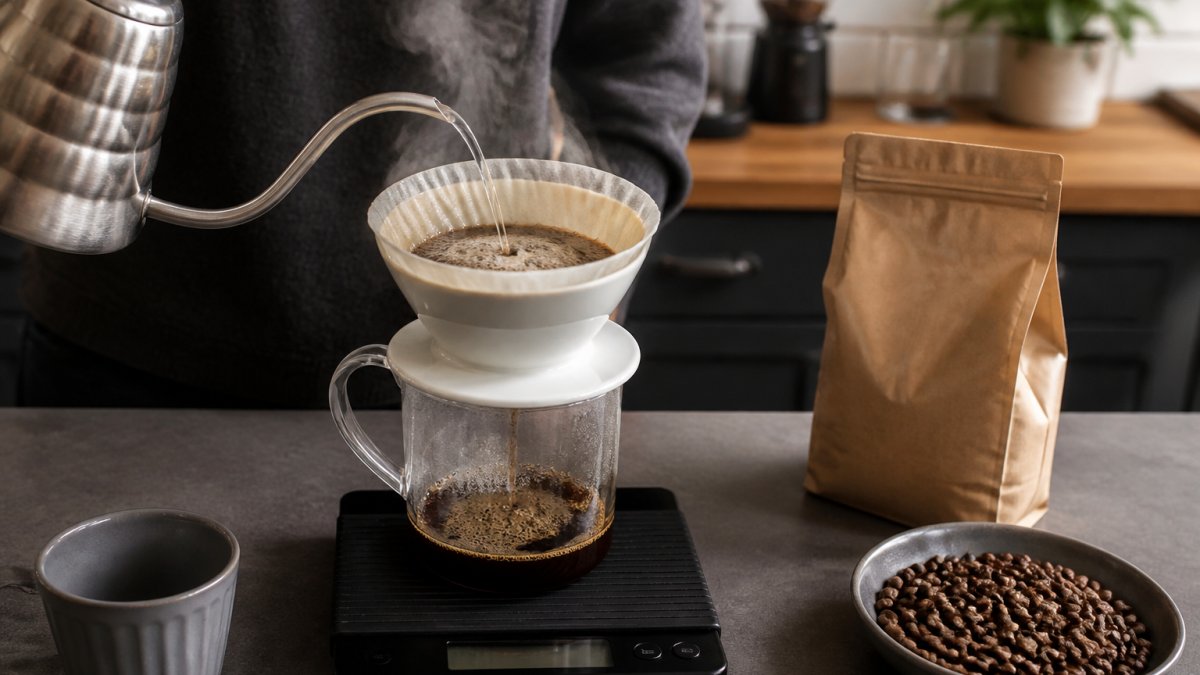
Lighter roasts tend to shine with pour-over because the paper filter produces a clean, bright cup. Medium and darker roasts hold up well in espresso, where pressure and a finer grind create a concentrated shot with body.
Pour-Over, Espresso, and the Grind Size That Makes or Breaks Each
Grind size is the variable most home brewers get wrong. Too coarse and water runs through too fast, producing a weak, sour cup. Too fine and the water stalls, extracting bitterness and astringency.
- Pour-over: medium grind, roughly the texture of table salt. Use a 1:16 coffee-to-water ratio.
- Espresso: fine grind, like powdered sugar. Aim for a 1:2 ratio of coffee to liquid in 25-30 seconds.
- French press: coarse grind, like sea salt. Steep for four minutes.
- Cold brew: coarse grind, steeped 12-18 hours in cold water.
A digital scale and a burr grinder will improve your results more than any upgrade to your machine. Consistency beats equipment every time.
How to Choose and Store Specialty Coffee Beans
Buy whole beans with a roast date, not a best-by date, and use them within two to four weeks of roasting. Oxygen, heat, light, and moisture are the four enemies of freshness, and a bag with a one-way degassing valve handles all four better than a simple paper bag.
Store beans in an airtight, opaque container at room temperature. Skip the freezer unless you are storing a large amount long term; repeated thawing introduces moisture. Grind immediately before brewing, because ground coffee loses its aromatic compounds within hours.
At Coffee Love, we ship within two to three business days so beans arrive close to their roast date. Our Specialty Coffee Association quality standards framework guides how we evaluate every lot before it reaches your grinder.
Flavor Notes, Origins, and Processing Methods Explained
Flavor notes describe what a coffee tastes like, not what was added to it. Nothing is infused, flavored, or sprayed. A coffee labeled "nutty, sweet chocolate, mild citrus" tastes that way because of its genetics, where it grew, how it was processed, and how it was roasted. Learning to read those cues turns a bag of beans from a gamble into a predictable purchase.
Where Flavor Actually Comes From
Four variables do most of the work:
- Variety (genetics). Arabica and robusta are the two commercial species. Arabica generally has more acidity, more aromatic complexity, and less caffeine; robusta is hardier, higher in caffeine, and tends toward bitter, rubbery, or grainy notes. Within arabica, named varieties like Bourbon, Typica, Caturra, Gesha, and Pacamara each carry tendencies, Gesha is famous for floral and tea-like notes, Bourbon for sweetness and balance.
- Terroir (origin and altitude). Altitude slows cherry maturation, which concentrates sugars and acids in the bean. High-grown coffees (roughly 1,200-2,000 meters) tend to be denser, brighter, and more complex. Lower-grown coffees tend to be softer and less acidic. Soil, rainfall, and shade also leave fingerprints.
- Processing. As covered above, washed coffees read clean and bright, naturals read fruity and heavy, and honey coffees sit in between. Processing is often the single biggest lever a producer can pull on flavor after picking.
- Roast level. Light roasts preserve acidity and origin character; darker roasts trade those for caramelized, smoky, and bittersweet notes. Two coffees from the same farm roasted differently will taste like different coffees.
How to Read Tasting Notes Without Rolling Your Eyes
Tasting notes are a vocabulary, not a promise. When a bag says "stone fruit," it does not mean someone added peach, it means the coffee shares aromatic compounds with peaches. The same chemical family that gives a ripe peach its smell also appears in some coffees, and trained cuppers use the closest familiar reference to describe it.
A few practical translations:
- "Bright" or "juicy" usually means noticeable acidity, a lively, mouth-watering sensation, not sourness.
- "Clean" means no off-flavors or defects; the cup tastes transparent.
- "Body" is the tactile weight, think skim milk versus whole milk.
- "Sweet" in coffee usually refers to caramel, brown sugar, or fruit sweetness, not added sugar.
- "Earthy" or "herbal" often signals Southeast Asian or Indonesian origin, or a wet-hulled process.
- "Fermented" or "boozy" typically points to a natural or anaerobic process.
If a note sounds unfamiliar, treat it as a hypothesis. Brew the coffee two or three ways and see which reference you actually taste. Palate training is repetition, not talent.
Origin Tendencies Worth Knowing
These are broad patterns, not rules, variety, altitude, and processing can override any of them.
- Central America (Guatemala, Costa Rica, Honduras, Panama): often balanced, with chocolate, caramel, and mild citrus. Panama is home to Gesha lots known for floral, jasmine-like character.
- South America (Colombia, Peru, Brazil): Colombia and Peru lean sweet and nutty with soft acidity; Brazil is the workhorse of the coffee world, with lower acidity and chocolate, peanut, and caramel notes that anchor most espresso blends.
- East Africa (Ethiopia, Kenya, Rwanda): high-grown and often the brightest coffees on a menu. Ethiopia is the birthplace of coffee and produces a huge range of heirloom varieties with berry, floral, and tea-like notes; Kenya is known for intense blackcurrant-like acidity.
- Southeast Asia and the Pacific (Indonesia, Sumatra, Papua New Guinea): typically heavy-bodied, low-acid, and earthy or herbal, often from wet-hulled processing.
A Practical Buying Framework
If you know what you like, work backward:
- Want a bright, tea-like cup? Look for a light-roasted washed Ethiopian or Kenyan.
- Want fruit-forward and heavy? Look for a natural-process coffee from Ethiopia or Brazil.
- Want chocolate and caramel for espresso? Look for a medium-roasted Brazilian or Colombian, or a blend built around them.
- Want something unusual? Look for anaerobic or experimental lots, but expect a wider swing between hits and misses.
Frequently Asked Questions
What is meant by specialty coffee?
Specialty coffee is coffee that scores 80 points or higher on a 100-point scale used by licensed graders. The score reflects bean quality, flavor, and freedom from defects. It is grown at high altitude, picked ripe, processed carefully, and roasted to highlight its natural flavors. Unlike commodity coffee, which is judged mainly on price and consistency, specialty coffee is judged on taste and traceability, from farm to cup.
How is specialty coffee different from regular coffee?
Regular coffee is typically a blend of lower-grade beans, roasted dark to mask defects, and sold without origin details. Specialty coffee is traceable to a farm or cooperative, roasted lighter to preserve flavor, and brewed to bring out specific tasting notes. The difference shows up in the cup: regular coffee tastes bitter or flat, while specialty coffee can be sweet, fruity, or floral with a clean finish.
Is organic coffee the same as specialty coffee?
No. Organic certification refers to how the coffee is grown, without synthetic pesticides or fertilizers. Specialty coffee refers to quality and taste, as measured by cupping score. A coffee can be organic but not specialty, or specialty but not certified organic. Some farms use organic practices without paying for certification. For the best of both, look for beans that are both certified organic and scored 80+.
What is the best way to brew specialty coffee at home?
For most people, a pour-over cone or a French press delivers the clearest flavor. Use a burr grinder, weigh your beans (about 15 grams per 250 ml of water), and aim for a water temperature between 195°F and 205°F. A 1:16 coffee-to-water ratio works well as a starting point. Adjust grind size to taste: finer for more extraction, coarser for less. Freshly roasted beans make the biggest difference.