
Table of Contents
- How Much Coffee for 12 Cups of Water: The Short Answer
- How Many Scoops of Coffee for 12 Cups
- How Many Tablespoons of Coffee for 12 Cups
- The Coffee to Water Ratio That Actually Works
- 12-Cup Coffee Maker Measurements: What the Markings Really Mean
- How to Measure Coffee by Weight for Consistency
- How to Adjust for Stronger or Weaker Coffee
- Conclusion
- Frequently Asked Questions
Last Updated: October 7, 2026
How Much Coffee for 12 Cups of Water: The Short Answer
For a full 12-cup pot, use 24 tablespoons of ground coffee, which is about 1.5 cups of grounds or 12 level scoops.
Here's the catch most people miss: a "12-cup" coffee maker doesn't brew 12 standard cups. It brews about 60 ounces, or five standard 12-ounce mugs. So the real question isn't just how much coffee for 12 cups of water.
Get that right and you fix the two most common problems in home brewing: weak, watery pots and bitter, over-extracted ones.
Below, we'll show you exactly how to measure by scoop, tablespoon, and weight, plus how to adjust for your own taste.
How Many Scoops of Coffee for 12 Cups
The short answer is 12 level scoops for a 12-cup pot, assuming a standard 1-tablespoon scoop. That's 12 scoops, or 24 tablespoons total.
Scoop size is where most brews go wrong. Coffee scoops sold with machines usually hold 1 tablespoon, but some hold 2. A heaping scoop can double your dose. So check your scoop once with a measuring spoon, then trust it.
Here's how the numbers stack up:
- 1 level scoop = 1 tablespoon of ground coffee
- 12 scoops = 24 tablespoons = about 1.5 cups
- 1 scoop per 6 ounces of water is the working rule
A common mistake is scooping straight from the bag with a wet spoon. Moisture clumps the grounds and throws off your count.
How Many Tablespoons of Coffee for 12 Cups
The answer is 24 tablespoons, or 1.5 cups of ground coffee, for a full 12-cup pot. That figure assumes a 1:16 coffee-to-water ratio and a machine that brews about 72 ounces.
Why 24? It's simple math. One tablespoon of coffee per 6 ounces of water is the baseline. A 12-cup maker brews roughly 72 ounces, so 72 divided by 6 gives you 12. Double that for the standard 2-tablespoon scoop per cup, and you land on 24.
A few practical notes:
- Level your tablespoons with a straight edge, not a rounded scoop.
- Measure before you grind if you use whole beans. Ground coffee settles and packs.
- Keep a spare tablespoon in the drawer for quick, even scoops.
If your pot tastes thin, you're likely under-measuring. If it's harsh and bitter, you've gone over. Both are easy fixes.
The Coffee to Water Ratio That Actually Works
The ratio that works for most people is 1:16, one part coffee to 16 parts water by weight. It's often called the golden ratio.
Here's how it looks in practice:
| Method | Coffee | Water | Ratio |
|---|---|---|---|
| Standard drip | 1 tablespoon | 6 oz | 1:16 |
| Full 12-cup pot | 24 tablespoons | 72 oz | 1:16 |
| By weight | 60 grams | 1,000 grams | 1:16 |
| Stronger brew | 1 tablespoon | 5 oz | 1:13 |
| Weaker brew | 1 tablespoon | 7 oz | 1:18 |
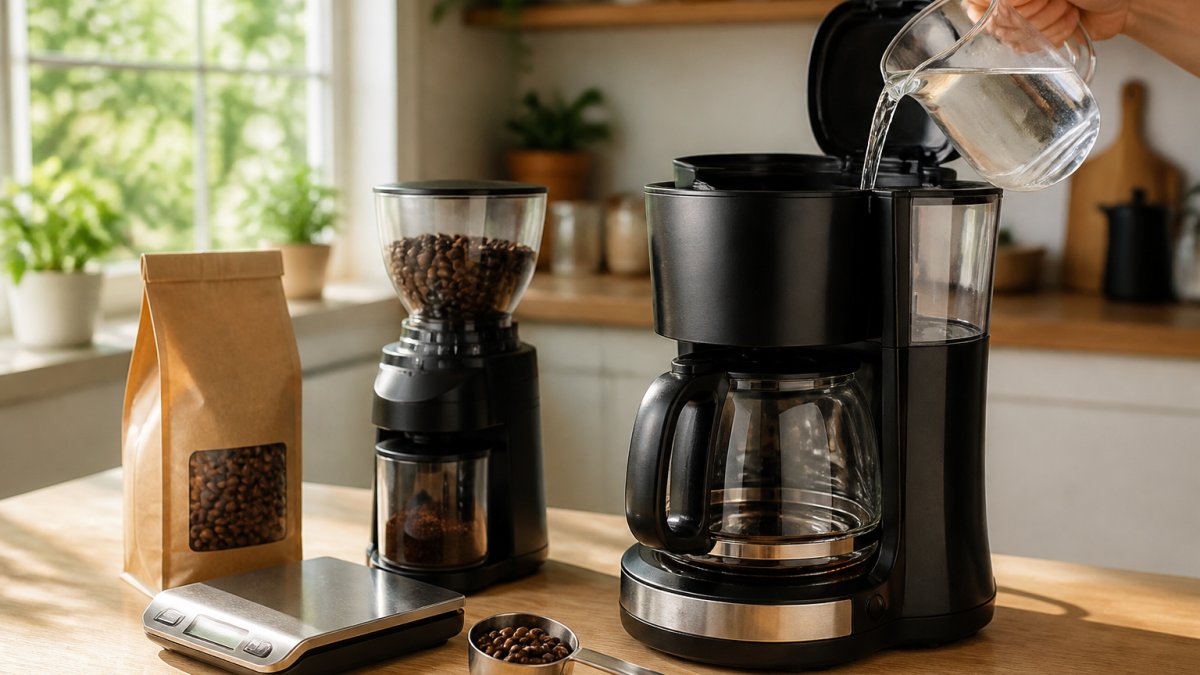
What most guides skip: ratio is about weight, not volume. A tablespoon of fine grind weighs more than a tablespoon of coarse grind. That's why serious brewers switch to a scale.
12-Cup Coffee Maker Measurements: What the Markings Really Mean
A 12-cup coffee maker does not brew 12 standard cups. The carafe is marked in brewer cups, and a brewer cup is about 5 fluid ounces, not the 8 fluid ounces in a standard measuring cup. So a full 12-cup pot holds roughly 60 fluid ounces of water, about five 12-ounce mugs, not twelve 8-ounce cups.
That single fact changes your coffee dose. The 72-ounce figure used earlier in this guide assumes a machine that actually holds 72 ounces. Many 12-cup machines hold closer to 60. If you dose for 72 ounces and brew 60, you get a bitter, over-extracted pot. If you dose for 60 and brew 72, you get dishwater.
Here is the breakdown:
| Measure | Volume |
|---|---|
| 1 brewer cup | 5 fl oz |
| 12 brewer cups (carafe mark) | 60 fl oz |
| 1 standard US cup | 8 fl oz |
| 1 large mug | 12 fl oz |
| 12 brewer cups in mugs | 5 mugs |
Why the numbers vary between machines
Brewer cup size is not standardized. Some manufacturers define it as 5 fluid ounces, others as 5.5 or 6. A machine labeled "12-cup" can therefore hold anywhere from about 60 to 72 fluid ounces. That range is the single biggest reason coffee recommendations for 12 cups disagree across pages, each one assumes a different water volume.
What the pot actually yields
Ground coffee absorbs water. A common rule of thumb is that coffee retains roughly its own weight in water during brewing. A 60-ounce brew with 60 grams of grounds loses a small but noticeable amount to the spent bed, so the carafe ends up holding slightly less than the water you poured in. Plan for roughly 55 to 58 fluid ounces of drinkable coffee from a 60-ounce fill, about four and a half to five mugs.
How to find your machine's real volume
- Fill the reservoir to the 12-cup line with water.
- Pour that water into a liquid measuring cup and read the total in fluid ounces.
- Divide by 12 to get your machine's brewer-cup size.
- Match your coffee dose to the measured water volume, not the label.
If your measured volume is 60 ounces, use about 20 tablespoons of coffee at 1:16. If it is 72 ounces, use 24. That one measurement resolves most weak-pot and bitter-pot complaints before you touch the grind.
How to Measure Coffee by Weight for Consistency
Weighing coffee is the most repeatable way to brew, because a tablespoon of fine grind and a tablespoon of coarse grind do not weigh the same. Weight ignores grind size, scoop shape, and how tightly the grounds settled in the bag.
Here is how that scales to the water volumes you might actually have:
| Water volume | Coffee at 1:16 | Coffee at 1:15 (stronger) | Coffee at 1:17 (weaker) |
|---|---|---|---|
| 60 fl oz (1,775 g) | 111 g | 118 g | 104 g |
| 66 fl oz (1,950 g) | 122 g | 130 g | 115 g |
| 72 fl oz (2,130 g) | 133 g | 142 g | 125 g |
Notice that none of these land on the round "60 grams" figure that circulates widely. That number assumes a 1,000-gram (about 34-ounce) brew, which is closer to a 6- or 8-cup pot than a full 12-cup one. It is a fine starting point for a smaller batch, but it under-doses a full carafe.
A quick conversion you can do in your head
One fluid ounce of water weighs about 29.57 grams. So:
- 60 fl oz × 29.57 ≈ 1,775 g of water
- 1,775 ÷ 16 ≈ 111 g of coffee
If you would rather work in tablespoons, 1 level tablespoon of medium-grind coffee weighs roughly 5 to 6 grams. That puts 111 grams at about 19 to 22 tablespoons, consistent with the 20-tablespoon figure for a 60-ounce pot in the previous section.
Step-by-step weighing method
- Place your carafe or a small bowl on a digital scale and press tare.
- Add grounds until the scale reads your target, for example, 111 g for a 60-ounce pot.
- Set the grounds aside and place the empty reservoir or a pitcher on the scale. Tare again.
- Fill with water until the scale reads your water target, or measure the water by volume and trust the conversion above.
- Brew, taste, then adjust the coffee weight by 5 grams at a time.
Why weight beats scoops for repeatability
A scoop is a volume tool, and volume shifts with grind, moisture, and how the coffee was packed. Two scoops from the same bag can differ by several grams depending on whether the grounds were fluffed or settled. A scale removes that variable entirely. A basic digital kitchen scale that reads to 1 gram is inexpensive and lasts for years, for anyone chasing the same cup twice, it is the single best upgrade.
For more on how grind and method change your results, the National Coffee Association's brewing guidance covers the basics clearly.
How to Adjust for Stronger or Weaker Coffee
Adjust strength by changing the coffee, not the water. Adding more water dilutes flavor and can make the brew taste flat. Adding more coffee boosts body and intensity.
To go stronger, add 1 to 2 tablespoons per pot, or tighten the ratio to 1:14. To go weaker, cut back by 1 to 2 tablespoons, or loosen to 1:18.
Other levers matter too:
- Grind: Finer grind extracts more, coarser extracts less.
- Water temp: Aim for 195 to 205 degrees Fahrenheit.
- Brew time: Longer contact pulls more flavor, up to a point.
Our House Blend is a medium roast with nutty, sweet chocolate notes and a clean finish. It holds up well at 1:16 and stays balanced if you push it stronger.
The beans you choose set your ceiling. Fresh, well-roasted coffee tastes better at any ratio.
Conclusion
Getting a great 12-cup pot comes down to one habit: measure your water, then match your coffee to it. Most weak or bitter brews trace back to a guess, not a bad machine.
At Coffee Love, we make that part easy. Our beans are ethically sourced and roasted to bring out deep aroma and complex flavor in every cup. Try the House Blend for a smooth, balanced pot, or the Breakfast Blend for a lighter morning roast. Both ship fresh, and you can save 10% on orders over $15 with code Code10.
Frequently Asked Questions
How many scoops of coffee do I use for 12 cups?
For 12 cups of water (60 fluid ounces), use 12 level scoops of coffee if your scoop is 2 tablespoons. That equals 24 tablespoons total. If your scoop is 1 tablespoon, you'll need 24 scoops. Always level off each scoop for accuracy.
What is the golden ratio for coffee grounds to water?
The golden ratio for drip coffee is 1:16 to 1:18, meaning 1 part coffee to 16-18 parts water by weight. For 12 cups (60 fluid ounces) of water, that's about 100-113 grams of coffee. This ratio produces a balanced cup that suits most tastes. Adjust slightly stronger or weaker to match your preference.
Is a coffee scoop 1 or 2 tablespoons?
Not all coffee scoops are standard; some hold 1 tablespoon, while others hold 2. Check your scoop's capacity by measuring how many tablespoons it takes to fill it. Using the wrong scoop size can throw off your coffee-to-water ratio and lead to weak or bitter coffee.
How many grams of coffee should I use for 12 cups of water?
For 12 cups (60 fluid ounces) of water, use 100 to 113 grams of coffee for a balanced brew. This range follows the 1:16 to 1:18 ratio. A digital kitchen scale is the most accurate way to measure. If you prefer stronger coffee, aim for 113 grams; for weaker, use 100 grams.
Brewing for a crowd shouldn't mean guessing. Start with 24 tablespoons for a full pot, weigh it if you want consistency, and adjust from there. Shop now at Coffee Love and taste the difference mindful sourcing makes in your daily cup.